Fall 2026 registration is open;
course descriptions are at the bottom of this page
and faculty bios are here
Click here for academic year calendar
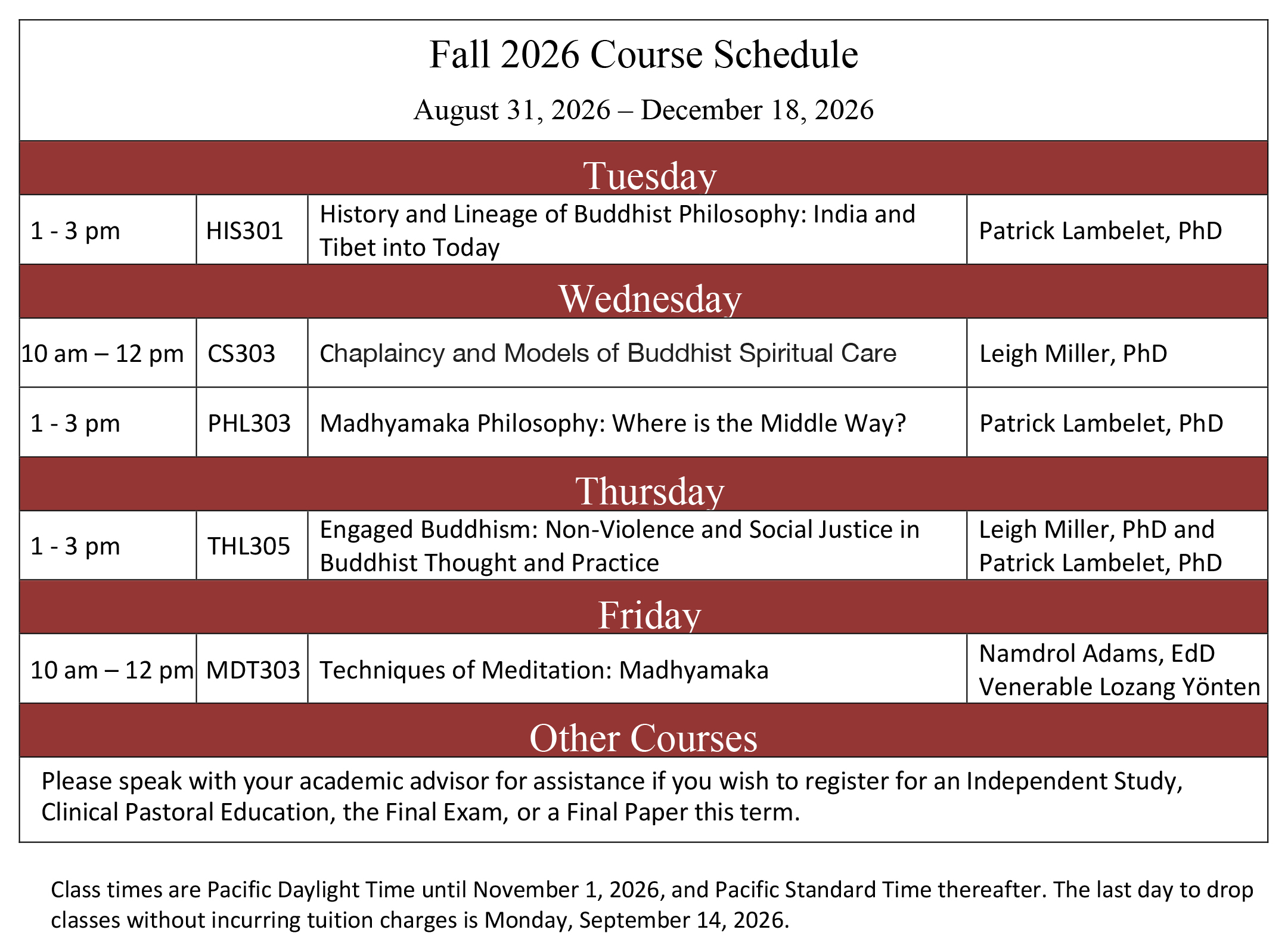
Fall 2026 Course Descriptions
HIS301: History and Lineage of Buddhist Philosophy: India and Tibet into Today (2 credits)
This course is a broad survey of the intellectual and cultural history of Buddhism in India and Tibet. The course will examine the social and historical dimensions of Buddhism as well as its core philosophical traditions.
The course will begin with Buddhism’s emergence in the context of the Vedic and Brahmanical traditions. We will then examine core Buddhist concepts of the early Indian Buddhist schools, such as the three jewels, the four noble truths, rebirth, and karma. We will then look at the development of the Great Vehicle (Mahāyāna) schools, reading writings by key Mahāyāna figures and discussing the main philosophical schools, doctrines, and debates with earlier Buddhist schools. We will then discuss the rise of Tantric Buddhism (Mantrayāna), considering its key doctrines, texts, and practices and their relation to non-tantric Mahāyāna schools.
The second part of the course will examine the transmission of Buddhism from India to Tibet, looking at the two main premodern historical periods of Tibetan Buddhism: the earlier dissemination (ngadar) and the later dissemination (chidar). Here, we will discuss key points of the main Tibetan Buddhist schools (Nyingma, Kadam, Kagyu, Sakya, and Geluk), their founders and principal figures, key doctrines, philosophical views, and practices. We will consider the social, historical, and political factors that shaped the trajectory of Tibetan Buddhism.
In the final part of the course, we will discuss Tibetan Buddhism in the twentieth century and beyond, including its spread to the West, some of the key figures in this transmission, and the challenges in its encounters with modernity.
Course readings will include a selection of primary Indian and Tibetan sources, combined with contemporary scholarly and critical analyses.
MDT303: Techniques of Meditation: Madhyamaka (2 credits)
This course will introduce students to some of the key structures and approaches to Madhyamaka meditation on emptiness found within Tibetan Buddhism. The topics of this course will parallel those covered in PHL303 and students will have the opportunity to integrate their philosophical contemplation within their meditation. A blend of traditional preliminary practices, calm abiding, and specific wisdom meditations will be taught to provide a balanced and grounded framework for approaching profound meditations on the nature of reality. The course will also address common problems in establishing a meditation practice such as lack of time or inspiration. The class will consist of weekly meditations guided by the instructor, daily self-guided meditation integrating the weekly topics into the overall practice structure, three personal meditation reports, and the opportunity to meet with the instructor to design a personal meditation practice. Students are strongly encouraged to enroll in PHL303 in conjunction with this class.
PHL303: Madhyamaka Philosophy: Where is the Middle Way? (2 credits)
The Madhyamaka (Middle Way) school of Buddhism is considered by many Buddhists to be the pinnacle of Great Vehicle (Mahāyāna) philosophical thought. Followers of Madhyamaka emphasize the use of reasoning in order to realize the most subtle view of emptiness, which is understood as the key to attaining liberation from cyclic existence (saṃsāra) and full awakening (bodhi). This course provides an in-depth overview of the history, philosophy, and practice of the Madhyamaka school, which was founded by the Indian philosopher Nāgārjuna (ca. 150–200 CE).
The course will begin with a survey of Buddhist philosophical thought, situating the Madhyamaka school within the broader context of traditions such as the Abhidharma and Yogācāra schools. Our study of Madhyamaka will consist of readings from sūtras and commentarial writings by authors such as Nāgārjuna and Śāntideva, considering them alongside commentaries by contemporary Tibetan masters, including His Holiness the Dalai Lama. We will pay close attention to the writings of the Geluk school, reading selections by Jé Tsongkhapa (1357–1419) and his followers, and considering them in relation to non-Geluk interpretations of emptiness and Madhyamaka. Readings in traditional primary sources will be supplemented by writings by contemporary Western teachers, scholars, and contemplatives. Among the points we will consider are emptiness, dependent arising, the two truths, the “object of negation,” and the relationship between emptiness and the bodhisattva path. We will seek to understand the philosophical importance of these points as well as their relevance in the context of contemplative practice.
Students are strongly encouraged to enroll in MDT303 (Techniques of Meditation: Madhyamaka) in conjunction with this course.
PHL450: Theories & Methods of Buddhist Studies (2 credits)
This course is designed to give students the methodological and theoretical tools needed to think critically about ways to approach the academic study of Buddhism. What are the goals of Buddhist Studies? What are the best methods for achieving those goals? What sorts of presuppositions and assumptions do we bring into our work and our orientation towards “Buddhism”? Do our presuppositions and assumptions serve our goals? How do political, religious, and/or ideological preferences impact our engagement with the object of study? What are the authoritative sources for the information we want and how do we determine that? How do we understand and interpret the “data”? What sorts of responsibilities do scholars have? What we study and how we study it are inextricably tied to questions of theory and method. Those who see methodological discussions as needless academic meanderings do not somehow thereby free themselves of methodological biases. Everybody engages their object of study with a theoretical and methodological orientation. The goal of this class is to encourage students to do so consciously, to think about their own assumptions and the assumptions of the broader community of scholars who engage the Buddhist traditions within modernity and postmodernity.
THL305: Engaged Buddhism: Non-Violence and Social Justice in Buddhist Thought and Practice (2 credits)
Engaged Buddhism is the application of the Dharma to large and small scale problems that cause suffering in the world. Engaged Buddhism is a theoretical lens and set of movements and organizations dedicated to applying Dharma to understand what are often considered social and systemic causes suffering in the world, and the framework of Buddhist ethics that can be mobilized towards the alleviation of suffering and advancement of social good. Most commonly it is thought of as Buddhist social and political action, but whether and how this presumes particular issues, ideologies, or political orientations, and who defines “engaged”, are debated. Socially Engaged Buddhism is not aligned with any particular Buddhist denomination and can be found across the Buddhist world, in diverse forms. It has been defined in the past fifty years by leading Engaged Buddhist thinkers including but not limited to Ven. Thich Nhat Hanh, His Holiness the Dalai Lama, Sulak Sivaraksa, Samdhong Rinpoche, Bhikku Boshi, B. Ambedkar, Maha Gosananda, A.T Ariyaratne, Sallie King, Christopher Queen, Joana Macy, Joan Halifax, Roshi Bernie Glassman, and Peter Harvey, among others. As Buddhists in the US and internationally have more recently grappled with racial, gendered, sexual, religious, and political and nationalistic violences, the role of scholarship, theories, and skills from decolonial, anti-racist, new dharmic liberation theology, and justice movement perspectives have begun to influence the field and horizons of imagination and action. In this class we will investigate the kinds of activities Engaged Buddhists are doing to transform society and create a world that engenders our highest ideals and nurtures healing, compassion, and wisdom. The class will include foci chosen by students centered on specific topics and potential “engagements”, as fields for closer investigation and experimentation with course themes.