Study Buddhism Deeply ~ Bring It to Your Work
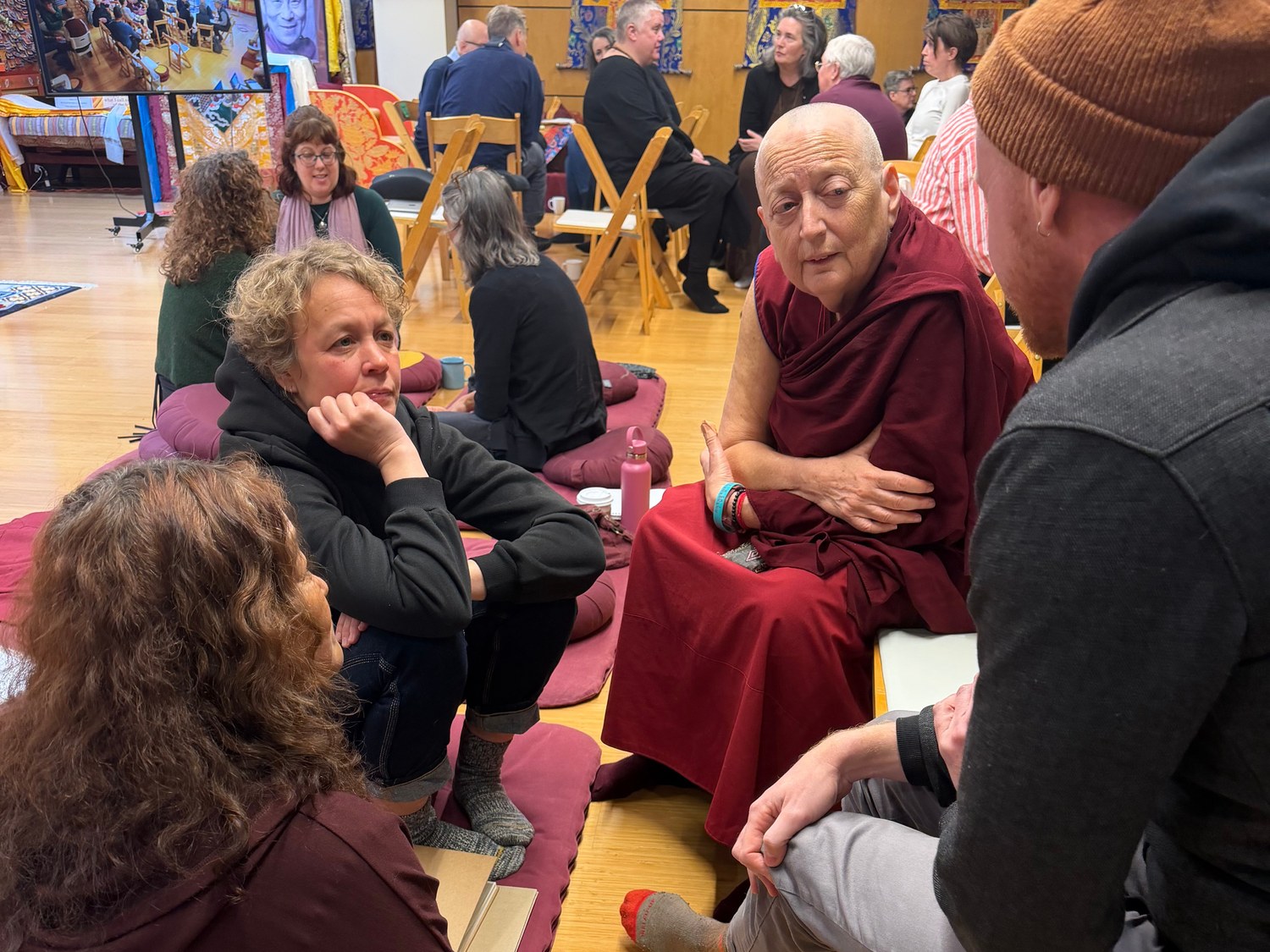
Integrate Buddhist Wisdom into Your Life and Work
The MA in Applied Buddhism is for people who want serious Buddhist study and practice without leaving the work they do. Over two years, you study classical texts with lineage-trained faculty, build a meditation practice, and bring both into your own field through a research project in your workplace or community.
MAAB at a Glance
Who This Program Is For
For those who want both intellectual depth and lived integration: serious Buddhist study and practice, woven into the work and life you already have.
You might be



Our alumni earned the MA in Buddhist Studies, the degree now offered in low-residency form as the MA in Applied Buddhism.
You usually already hold the credential your profession requires, and you are not looking for another one.
What we hear from working professionals
My training covers the technique. It doesn’t cover what I bring into the room.
Here, philosophy doesn’t stay theory. You study the Buddhist view of mind and suffering, test it against your own experience, and learn to see what you bring into the room: your assumptions, your biases, and your social location.
I want a practice that holds up under the work I do every day.
A practice that rests on understanding and technique. Three meditation courses build it in stages: concentration and analytical meditation, compassion cultivation, and sustaining compassion for oneself and others. Four Spiritual Formation Groups, taken with your cohort, support integrated study, practice, and personal reflection.
I want serious study without leaving my career or taking on debt.
A graduate degree built for working adults, paid as you go. See MAAB at a Glance for length, and Tuition & Funding for cost.
Not sure which degree? Ask yourself: in five years, are you doing the work you do now, or are you starting a new job as a spiritual care provider or chaplain?
Doing the work I do now
The MA in Applied Buddhism, on this page.
Providing spiritual care
I don’t know yet

The Maitripa College building in Portland, where residencies take place.
What You Want to Learn, and Where You’ll Learn It
The MAAB is built so your own work is where the degree is tested.
Read the tradition seriously
Bring it to your own field’s research
Explain it to people in your world
A practice that holds up when you’re under pressure
Develop your ethical framework for leadership
A real project where you work
See how it all fits together
Spiritual Formation Groups, four with your cohort
A faculty-guided cohort space where study, practice, and ethical development come together
FROM LAPIS
“Buddhism gave me tools to deal with high intensity people and situations.”

How Buddhist study and practice shaped her health care career, and what the degree added to her life.
Two Things That Make the MAAB Different
Spiritual Formation
When the study of Buddhist philosophy, meditation, and service come together, you discover how the integration is formational. In four Spiritual Formation Groups, taken with your cohort, you reflect on how that work is shaping you. What changes for you, and how, is yours to discover and to say.
Meet Your Faculty
Study with a small group of professors across the program, including visiting professors. See all faculty and visiting teachers →

Venerable Lozang Yönten
Meditation
A nun since 2003, a chaplain and FPMT-accredited teacher, and Abbess of the Maitripa Rabjungma Community.

Venerable Tenzin Drolma
Meditation
A nun since 2009 and a Maitripa MA graduate, after 25 years in the mental health field. Taught Introduction to Buddhism at Tushita Meditation Centre in India.

Namdrol Miranda Adams, EdD
Spiritual Formation Group; Self-Awareness and Social Engagement
President and a founder of Maitripa College. Has studied Tibetan language and Buddhism since 1998, as an editor and translator.

Tiffany Blumenthal Patrella, MA
Action Research Project
Director of Student Services. MA in Education, Portland State University, with a focus on curriculum development.

Patrick Lambelet, PhD
Philosophy and history
PhD in Religious Studies, UC Santa Barbara. Seven years in the FPMT Masters Program studying the major Geluk texts; translator for 84000.
The MAAB May Not Be the Right Fit If:
You want a chaplaincy credential → Learn more about Master of Divinity.
You want self-paced study → Learn more about Discovering Buddhism.
You can’t travel to Portland for two residencies a year.
You can’t set aside the weekly hours in MAAB at a Glance.
Not Sure You’re Ready? Start Here
Many people wonder whether graduate study is for them. Two questions come up most often.
“It’s been years since I was in school.”
You won’t do it alone. You study in a small cohort that moves through the program together, with an assigned faculty advisor and four Spiritual Formation Groups along the way. Faculty and staff are available for technical support, understanding how to use the library, and writing and research support.
“I’m new to Buddhism,” or “I practice in another tradition.”
Students come to us from many starting points: some are new to Buddhism, and some come from other traditions and other Tibetan Buddhist lineages. No one will be asked to give up their own practice. Maitripa teaches from the Gelug tradition of Tibetan Buddhism; if you’d like a feel for it first, Discovering Buddhism is a good place to begin.
A Maitripa’s community program, offered year-round. It’s a low-stakes way to study informally with us, get to know our tradition and community, and see how we learn, before you decide about a degree.
Where Our Students Live
You can enroll in the MA in Applied Buddhism if you live in one of these states. Coursework is online, and residencies are in Portland, Oregon.

Arizona

Florida

Idaho

Massachusetts

Nebraska

Oregon (Home Campus)

Tennessee

Texas

Washington

Wisconsin
Updated October 2026