What need is there to say more?
The childish work for their own benefit,
The Buddhas work for the benefit of others.
Just look at the difference between them.
– Shantideva
In Gratitude . . . a series focusing on the incredible gifts offered by a handful of people over the past 10 years to create the unprecedented project of Maitripa College.
This collection is a physical representation of the incredible dedication, expertise, love, and determination a very special group of people have brought to the Maitripa College project for only one purpose—the benefit of others. This page is intended as a focal point from which to recognize and rejoice in those efforts, and to inspire all those connected to Maitripa College to remember how far we have come, and dream about how far we will go.
Get Notified When Your State Opens
We’d love to hear from you Thank you for your interest in Maitripa College. Each state sets its own rules for colleges like ours, so for now we can only accept students who live in the states listed on our MA in Applied Buddhism and Master of Divinity pages. We’re working to change that. Leave your name and state below, and we’ll email you when we can accept students from where you live. Maitripa College is not yet institutionally accredited and therefore does not make any representation regarding its accreditation status. The College is preparing an initial application for accreditation with a USDE-recognized institutional accrediting agency in late October 2026. You don’t have to wait to study with us In the meantime, you’re welcome to join Discovering Buddhism, Maitripa’s community program, offered year-round, wherever you live.
Thank you for your generous gift
Thank you for your generous gift to Maitripa College’s Annual Fundraising Campaign Because of you, the light of wisdom and compassion continues to shine at Maitripa College, sustaining our faculty and staff, supporting our students, and keeping the doors of the Dharma open to our community. Your generosity strengthens every program we offer, from the classroom to the meditation hall, and helps carry forward the vision inspired by His Holiness the Dalai Lama, Yangsi Rinpoche, and the FPMT lineage of Lama Yeshe and Lama Zopa Rinpoche. May Compassion and Wisdom Serve the World. Your gift is a living expression of that mission, rooted in the three pillars of scholarship, meditation, and service that guide everything we do here. On behalf of our students, faculty, and the wider Maitripa community, thank you for helping keep this light alive for generations to come. With deep gratitude, The Maitripa College Team Maitripa College is a 501(c)(3) nonprofit organization. Your contribution is tax-deductible to the extent allowed by law.
Our Story
Our Name The name Maitripa was given to the College (originally Maitripa Institute) by Lama Zopa Rinpoche, the founder (with Lama Thubten Yeshe) and Spiritual Director of FPMT. Maitripa, whose name means “He Whose Protection Is Lovingkindness,” lived in the 11th century. He was the guru of the famed saint Marpa the Translator, and counted the eminent Naropa among his contemporaries and teachers. Maitripa spent time at Nalanda during the time of the great Atisha, and at Vikramashila University at the height of its fame in India. Maitripa was renowned as a great scholar and yogin, but was eventually expelled from the monastic community of Vikrasmashila when his yogic practice began to cause confusion among the monks. He continued his practice as a mahasiddha, and is particularly famed for his transmission of the mahamudra teachings and his teaching of the Uttaratantra Shastra. Maitripa was also well known for his spontaneous songs of spiritual realization. >READ Maitripa’s Essential Mahamudra Verses HERE Maitripa College Logo Maitripa’s logo was jointly designed by our teachers Lama Zopa Rinpoche and Yangsi Rinpoche. The image of the snow lion on the world globe represents courageously carrying on the turning of the Wheel of Dharma on behalf of all sentient beings, particularly in the West. In addition to the name of the College, the outer circle [...]
Library Fund
Sustaining the James A. Blumenthal Library At the heart of Maitripa College is the James A. Blumenthal Library, home to the texts, translations, and study materials that support our students, faculty, and wider community in the study and practice of the Dharma. As our programs and community continue to grow, so does the need for updated resources, digital access, and expanded materials for the students who will study here in years to come. Your gift to the Library Fund helps preserve, expand, and make accessible these teachings, ensuring the wisdom of the lineage remains available not only to our current students, but to scholars and practitioners for generations. Give $21, $54, or $108, to help keep the library’s shelves and digital resources growing for the students who will study here next. Library Fund Annual Fundraising Campaign
Friends of Maitripa
Join Our Community of Monthly Members Friends of Maitripa are the steady heartbeat behind everything we do. A recurring monthly gift, at whatever level feels right to you, gives Maitripa College the stability to plan, sustain our teachers and staff, and keep growing as a place of genuine dharma practice and academic rigor. As a Friend of Maitripa, you’ll receive early notice of events and retreats, special member rates on workshops, unlimited access to our ongoing teachings and practice sessions, and patronage privileges at the James A. Blumenthal Library. You’ll also be the first to hear, through regular updates, exactly what your generosity makes possible. $54 a month helps cover the everyday cost of running our programs. $108 a month helps fund our generosity policy, so monastics and those facing financial hardship are never turned away from Maitripa’s teachings. $216 a month partners directly in our growth, helping us build new offerings for years to come. Choose your level below. Monthly gifts can be adjusted or cancelled at any time. Friends of Maitripa Annual Fundraising Campaign
Attend an Info Session
Join Us for Maitripa College’s Monthly Online Prospective Student Info Session 1pm-2pm (Pacific) on the first Friday of the month These informal, welcoming sessions offer an opportunity to learn more about our graduate degree programs, our values, and our approach to education—and to ask any questions you may have. Fall semester sessions are held online at 1pm (PT) every first Friday of the month. You’re welcome at whichever session(s) fits your life. Each session will include: An introduction to Maitripa College and our degree programs An overview of our core values: community, spiritual formation, and the integration of scholarship, meditation, and service Time to share what you are looking for in a graduate program Q&A Community Events overview Whether you are actively considering applying or simply exploring your next step, we warmly invite you to join us and learn more about the Maitripa community. Zoom only (link is provided upon registration) - all are welcome.
Contact Us
We look forward to hearing from you! If you live in - or plan to visit - the Portland, Oregon area and have an interest in Tibetan Buddhism, Buddhist scholarship, or meditation, please attend one of our events, take a class, or contact us to arrange a visit or online conversation - and be sure to join our e-list for regular event notices. Location 1119 SE Market St. (cross street SE 11th, 3 blocks south of Hawthorne) Portland, Oregon 97214 Telephone 503-235-2477 General Information: info@maitripa.org Public Programs: program@maitripa.org Chaplain: l.yonten@maitripa.org President: education@maitripa.org Registrar: registrar@maitripa.org Library: library@maitripa.org Student Services: studentservices@maitripa.org Volunteer: volunteer@maitripa.org Join Our E-List Please join our email list to receive latest news and notices. It's simple and we never share your information. You can unsubscribe at any time. Join Our Elist
We Received your Inquiry!
Thank you for your interest in Maitripa College, we’re pleased you found us! Beginning in Fall 2027, Maitripa College will launch two Low-Residency programs: Master of Arts in Applied Buddhism (MAAB): A low-residency MA integrating Buddhist philosophy, meditation, and contemplative education (2 years, 34 credits) Master of Divinity (MDiv) : Become a Buddhist Chaplain: A low-residency contemplative MDiv preparing you for spiritual care in healthcare, hospice, corrections, and community setting (4 years, 72 credits) Whether you are actively considering applying or simply exploring your next step, we warmly invite you to join us and learn more about the Maitripa community. No obligation, just a chance to learn and ask questions. Our Info Sessions are held on the 1st Friday of every month except January 2027 when it's on the 2nd Friday, 1–2 pm Pacific, on Zoom, and you're welcome at whichever session fits your life. These are the dates: 2026 Friday, November 6 1-2 pm Pacific Friday, December 4 1-2 pm Pacific 2027 Friday, January 8 1-2 pm Pacific Friday, February 5 1-2 pm Pacific Friday, March 5 1-2 pm Pacific Friday, April 2 1-2 pm Pacific Friday, May 7 1-2 pm Pacific Friday, June 4 1-2 pm Pacific Here is your join link: https://maitripa-org.zoom.us/j/86907337113 We’ll follow up with an email within one business day. [...]
You are signed up for a Prospective Student Info Session!
Thank you for your interest in Maitripa College, we look forward to meeting you! Prospective Student Info Sessions are held on the 1st Friday of every month except January 2027 when it's on the 2nd Friday, 1–2 pm Pacific, on Zoom. You’re welcome at whichever session(s) fits your life. This is an informal, welcoming hour with our admissions team and faculty. Whether you are actively considering applying or simply exploring your next step, we warmly invite you to join us and learn more about the Maitripa community. No obligation, just a chance to learn and ask questions. 2026 Friday, November 6 1-2 pm Pacific Friday, December 4 1-2 pm Pacific 2027 Friday, January 8 1-2 pm Pacific Friday, February 5 1-2 pm Pacific Friday, March 5 1-2 pm Pacific Friday, April 2 1-2 pm Pacific Friday, May 7 1-2 pm Pacific Friday, June 4 1-2 pm Pacific Here is your join link: https://maitripa-org.zoom.us/j/86907337113 Each session will include: An introduction to Maitripa College and our degree programs An overview of our core values: community, spiritual formation, and the integration of scholarship, meditation, and service Time to share what you are looking for in a graduate program Open Q&A on topics such as: Applying, enrolling, and attending classes Program delivery formats (low-residence, hybrid, and [...]
Working with Anger
CLICK HERE TO DOWNLOAD A COPY OF THIS RESOURCE GUIDE. ABOUT THIS GUIDE Buddhism distinguishes anger from simply feeling upset or recognizing injustice. Rather, anger is understood as "the wish to harm." Left unchecked, it disturbs our peace, damages relationships, and creates suffering for ourselves and others. Buddhist practice offers methods to prevent anger, purify it when it arises, and ultimately uproot its deepest causes. REFLECTION “When the environment and its inhabitants overflow with unwholesomeness, Transform adverse circumstances into the path to enlightenment.” – Geshe Chekawa, The Seven Point Mind Training BOOKS 1) Healing Anger by His Holiness the Dalai Lama 2) Feeding Your Demons: Ancient Wisdom for Resolving Inner Conflict by Tsultrim Alloine For kids Anh's Anger by Gail Silver, Illustrated by Christiane Krömer (Free video available of Ven. Yönten reading this book on her YouTube channel) Tiger-Tiger is it True? By Byron Katy (Free video with short teaching by Ven.Yönten) TALKS & TEACHINGS Dealing with Anger and Emotions, video teaching by His Holiness the Dalai Lama, (1997) Free on the Meridian Trust Website Understanding Anger and Developing Patience, a Public talk at Maitripa College by Ven. Yönten (April 2026): Free on YouTube Working With Anger and Developing Patience, guided meditations and talk From the Lamrim tradition [...]
Compassion Guide
CLICK HERE TO DOWNLOAD A COPY OF THIS RESOURCE GUIDE ABOUT THIS GUIDE Compassion is a deeply complex Buddhist concept which includes not only empathy but also a strong determination to help. These teachings always have us start with ourselves. If we have no awareness of our own suffering and our own wish to free ourselves from that suffering, then we won’t be able to truly benefit others. Developing self-compassion and then bringing that strength to compassion for others is the way Buddhists train. REFLECTION “Compassion is the best healer. The most powerful healing comes from developing compassion for all other living beings, irrespective of their race, nationality, religious belief, or relationship to us. We need to feel compassion for all living beings, every single one of whom wants happiness and does not want suffering. We need to develop not only compassion, the wish to free everyone from all suffering, but great compassion, which means taking upon ourselves the responsibility for doing this. This brings deep and powerful healing.” – Ultimate Healing: The Power of Compassion by Lama Zopa Rinpoche, pg. 21 Books Hopkins, J. (2001). Cultivating compassion: A Buddhist perspective. Broadway Books. Jinpa, T. (2016). A fearless heart: How the courage to be compassionate can transform our lives. [...]
Emptiness Guide
CLICK HERE TO DOWNLOAD A COPY OF THIS RESOURCE GUIDE. ABOUT THIS GUIDE Much of our suffering comes from believing that people, situations, and even our own identity exist in a fixed and independent way. Buddhism calls this misunderstanding the root of suffering. The study and meditation on emptiness help us see ourselves and the world more accurately, leading to greater freedom, compassion, and peace. REFLECTION “As human beings we are as impermanent as everything else is. Every cell in the body is continuously changing. Thoughts and emotions rise and fall away unceasingly. When we're thinking that we're competent or that we're hopeless--what are we basing it on? On this fleeting moment? On yesterday's success or failure? We cling to a fixed idea of who we are and it cripples us. Nothing and no one is fixed.” – Chödrön, Pema. The Places That Scare You: A Guide to Fearlessness in Difficult Times. Boston: Shambhala Publications, 2001. Books Dalai Lama. (2006). How to see yourself as you really are. Atria Books. Tegchok, G. J. (2007). Insight into emptiness. Snow Lion Publications. Tsering, G. T. (2010). Emptiness: The foundation of Buddhist thought (The Foundation Series). Wisdom Publications. Talks and Teachings Teaching by Lama Zopa Rinpoche on Emptiness from a Kopan Course [...]
Buddhist Resource Guide Series: Death and Dying
CLICK HERE TO DOWNLOAD A PDF OF THIS GUIDE. ABOUT THIS GUIDE Buddhism views awareness of death not as something morbid, but as a powerful support for living wisely. Reflecting on our mortality helps clarify our priorities, deepen meditation, and prepare us for death with greater peace and confidence. In this way, remembering death becomes a way of fully valuing life. REFLECTION “This life is as impermanent as a water bubble; Remember how quickly it decays and death comes.” – Lama Tsong Khapa, The Foundation of All Good Qualities BOOKS 1) Advice on Dying by His Holiness the Dalai Lama 2) Dying With Confidence: A Tibetan Buddhist Guide for Preparing for Death by Anyen Rinpoche 3) How You Live is How You Die by Pema Chodron For kids A Peaceful Piggy’s Guide to Sickness and Death, Sadness and Love by Kerry Lee MacLean TALKS & TEACHINGS 1) No Regrets: Dalai Lama’s Advice for Living and Dying, at Karuna Hospice 2007 Free on YouTube 2) Buddhist Tools for Facing Death: Living with the Imminence of Death, at Maitripa College 2025 with Ven. Yönten Free on YouTube PRACTICE 1) Wholesome Fear: Transforming Your Anxiety About Impermanence and Death by Lama Zopa Rinpoche 2) Guided Meditation 8 'Stages of death' Meditation led by Venerable Yönten Free on YouTube [...]
Buddhist Resource Guide Series
Please click on the links below to view and/or download a copy (PDF) of the resource guides in this series. The online guides contain live links to resources of interest to the student and practitioner: Anxiety Guide Compassion Guide Death and Dying Guide Emptiness Guide Working with Anger Guide

2027 Low-Residency Transformation: A New Chapter for Graduate Study
Beginning in Fall 2027, Maitripa College will inaugurate a new chapter in its graduate programs with the launch of new low-residency models for both the Master of Arts in Applied Buddhism and the Master of Divinity. This transition represents not a departure from Maitripa's distinctive educational identity, but a deepening of it — an intentional effort to translate our integrated pedagogy of scholarship, meditation, and service into flexible online and hybrid formats that extend access across geography and life circumstance. Faculty and academic leadership are currently engaged in the careful work of curriculum design and pedagogical development, ensuring that the relational depth, contemplative formation, and lineage-rooted rigor that define a Maitripa education are fully preserved and expressed within the low-residency model. This transformation is being undertaken in alignment with accreditation standards and reflects our commitment to serving a wider community of students who seek authentic, values-driven graduate formation in the Buddhist tradition.
Maitripa Rabjungma Community
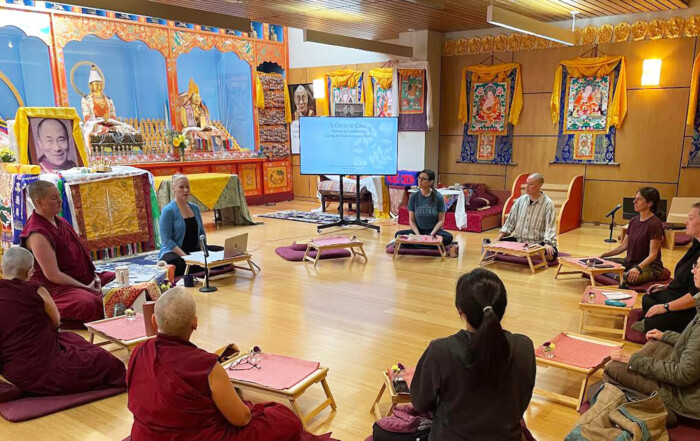
The Maitripa Rabjungma Community is a lineage-rooted formation pathway for women pursuing Buddhist ordination and long-term spiritual leadership, integrating rigorous study, Vinaya training, contemplative practice, retreat, and communal life within the living Nalanda tradition. As the Community completes its inaugural year, this pioneering program continues to demonstrate what it means to cultivate ethical, scholarly, and spiritually mature women as teachers, scholars, and stewards of the Dharma for generations to come. Applications for entry in Summer 2027 will be available this fall, and we invite those who feel called to this path to begin discerning whether the Rabjungma Community may be their next step. To stay informed about the program, upcoming information sessions, and the application process, please sign up for updates and visit (click here).
Maitripa College at the Forefront of Higher Education
At a moment when higher education is reckoning with deep questions of purpose, pedagogy, and institutional culture, Maitripa College finds itself not catching up — but already there. The insights brought home from the DEAC Annual Meeting in Washington, D.C. this April (2026) confirm what has long been true of Maitripa: our commitment to human connection, meaning-making, and learner-centered formation is precisely what the broader field is now striving to become. In response to the convergent pressures reshaping higher education — the centrality of professional instructional design in online curriculum development, the institutional imperatives posed by artificial intelligence, the severity of the current federal policy environment, the cultural conditions required for faculty and student flourishing, and the urgent need to articulate institutional value with clarity and evidence — Maitripa's leadership has developed a concrete action plan. This includes embedding instructional design expertise at the heart of its low-residency transition, developing an AI governance framework, engaging higher education advocacy channels, strengthening the cultural conditions that define institutional life, and completing a forthcoming document, The Case for Formation: Articulating Institutional Value at Maitripa College, which will bring together alumni outcomes, a position paper on formation-based graduate education, employer partnerships, and our no-debt commitment into a coherent and confident institutional narrative.
Action Research Project (Capstone)
The Action Research Project is where the MA in Applied Buddhism comes to life. This capstone integrates students’ development as scholar–meditator–practitioners through a values-based, action-oriented research process. Grounded in action research methodology and contemplative inquiry, students design a practitioner-led project to improve practice within a specific community, institutional, ministerial, or social context. Through cycles of inquiry, action, observation, and reflection, students identify a lived-practice concern, situate it in relevant scholarly and Buddhist contexts, and develop an ethically grounded plan for action and investigation. Emphasis is placed on reflexivity, relational accountability, and integrating Buddhist values in both the research design and the researcher’s stance.
Minimum Technology Requirements
The Maitripa College hybrid low-residency model offers students both onsite and online course delivery formats, creating the conditions for an educational journey grounded in spiritual and community formation. A computer (ideally a laptop) is required for all degree, continuing education, and auditing students. This document describes the minimum technology requirements students must meet in order to ensure a reliable and effective learning experience at Maitripa College. Students are responsible for ensuring their equipment and internet access meet these requirements before beginning coursework. 1. Recommended Student Computer Specification The following specifications ensure smooth performance for online learning, document editing, web browsing, video conferencing, and multitasking between applications: Operating System: Windows 11, macOS 12+, or Linux (Ubuntu 20.04+, Fedora 35+, or similar modern distributions) Processor: Intel Core i5 (11th gen or newer) or AMD Ryzen 5 5000 series or Apple M1/M2 RAM: 8 GB minimum, 16 GB preferred Storage: 256 GB SSD minimum, 512 GB preferred Display: 1920 x 1080 (Full HD) Webcam: 720p or better (required for synchronous sessions) Internet: 10+ Mbps broadband (wired or reliable Wi-Fi) Audio: Built-in speakers/microphone or USB headset 2. Required Institutional Platforms Maitripa College uses the following platforms to deliver coursework, facilitate communication, and support academic operations. All students must be able to access and use these platforms. Account credentials and on-boarding instructions [...]
Dr. Willis on Scholar-Practitioners
Please enjoy this short clip:
Dr. Michael Ium (1984-2025)
The Maitripa College community mourns the sudden loss of a brilliant and most kind alum, Dr. Michael Ium (MA 2014). We delighted in his passion for Buddhist Studies and community while he was a student here, and have been so proud of his subsequent achievements and promising career. Michael will be missed by his many friends here. Dr. Michael Ium Michael Ium was born and raised in Toronto as the child of South Korean immigrants. He studied psychology at the University of Toronto, earning a BA in 2008. Becoming disillusioned with his subsequent career as a professional poker player, he wrote, “As a backpacker going through a quarter-life crisis, my interest in Tibetan Buddhism and the Geluk tradition was sparked by a ten-day ‘Discovering Buddhism’ retreat at Kopan Monastery [in Nepal] in 2011.” It was there that he learned about Maitripa College in Portland, Oregon, and enrolled that fall. Michael completed a Master of Arts in Buddhist Studies at Maitripa College, in 2014. He then received a prestigious Chancellor’s Fellowship and entered the PhD program at the University of California, Santa Barbara. He won a 2020 International Dissertation Research Grant from the American Academy of Religion, studying for over a year in India, and completed his PhD in 2023 with a dissertation entitled “The Early History of Ganden Monastery [...]